Oct 14, 2026Veterinary Equipment Guides
Planning a Horse or Cattle Surgical Table: Dimensions, Load and Room Checks
A practical planning guide for horse and cattle surgical tables: check space, rated load, power, positioning, cleaning and the final supplier drawing.
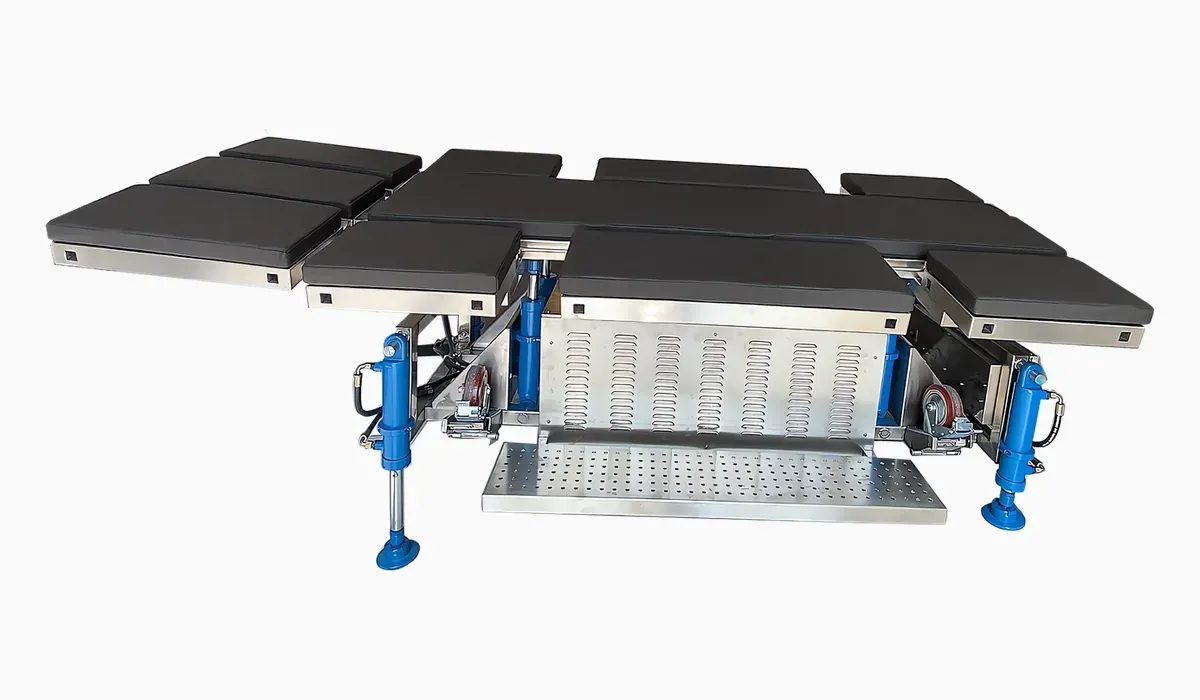
A horse or cattle surgical table is a room-planning decision as much as an equipment purchase. Before choosing a model, agree on the animals and procedures the clinical team will accommodate, then check the table's stated dimensions and load rating against the room, transfer route, power supply and cleaning workflow. A catalogue number alone cannot confirm that the final setup is suitable.
The cover shows the large-animal table pictured in the supplied product brochure. Confirm the exact model and final configuration on the current quotation and drawing.
Start with the numbers on the reference sheet
The supplied sheet lists overall dimensions of 2,820 × 1,180 mm and an adjustable height of 770–1,185 mm. It states a 1,500 kg bearing rating, a 460 kg net equipment weight and a 220 V, 50 Hz, 1,500 W power requirement. It also lists left-right angles of 0–30° and a front-back angle of 0–8°. Treat these as reference-sheet values until the supplier confirms the exact model and configuration for the order.
The sheet describes a 304 stainless-steel structure with a V-shaped cushioned surface and memory-rebound sponge. Ask which surfaces and pads are removable, which parts contact the patient, and which cleaning instructions apply to the final configuration. Do not assume that all visible materials can be cleaned in the same way.
Do not confuse rated load with floor loading
A 1,500 kg bearing figure describes a stated equipment rating; it does not by itself establish the suitability of every animal, position or floor. The facilities team needs the equipment weight, the expected animal range, the footprint and the actual support points to assess the room. Ask the supplier for a current load specification and installation drawing, and have the responsible veterinary and facilities professionals approve the intended use.
Measure the route into the room before ordering
The reference sheet gives a packed size of 2,915 × 1,280 × 1,070 mm and a gross weight of 510 kg. Check the unloading point, lift, doors, corridor turns and final room entrance against the supplier's actual crate drawing. The package dimensions are not a promise that it will pass through an opening of the same size: handling and turning space must be verified on site.
Plan access around the table, not just space for it
Mark the table at its stated lowest and highest positions on the room plan. Then mark where the team needs to stand, where transfer equipment will approach, and where cables and other equipment will sit. Ask for a demonstration of the exact controls and the usable adjustment range with the final accessories fitted. The clinical team should decide whether the positioning options match its own procedures and handling protocol.
Confirm the local electrical configuration
The brochure states 220 V, 50 Hz and 1,500 W. A clinic outside that supply standard should ask which electrical version can be supplied and what installation documentation accompanies it. The local qualified electrician should verify the circuit, outlet and safe cable route before the table arrives; the brochure does not establish local electrical compliance.
Make cleaning and maintenance questions specific
Ask how the cushioned sections are removed, how joints and the underside are accessed, and which approved cleaning agents may be used on pads and metal surfaces. Request the current user manual and maintenance instructions for the quoted configuration. A stainless-steel material description is useful, but it is not a complete cleaning protocol or maintenance schedule.
What to send with a first enquiry
Send a room sketch with clear dimensions; the doorway and delivery route; the intended animal size and weight range; local power supply; required table adjustments; preferred accessory and pad arrangement; and the destination country. Ask for a model-specific quotation, current technical sheet, final drawing and packaging dimensions. These documents let the clinic compare the proposed table with its actual room rather than a generic catalogue image.
Common questions about horse and cattle surgical tables
Is a 1,500 kg bearing rating enough for my clinic? It is one specification to check, not a stand-alone approval. Confirm the final model's rated conditions, animal range, support points and intended positioning with the supplier and the responsible clinical team.
Can I use the brochure dimensions as the installation drawing? No. The sheet is a useful starting point, but the order should be checked against a current model-specific drawing and the actual packed dimensions.
What should I confirm before requesting a quote? Have the room sketch, route measurements, local power details, animal range and required adjustments ready. Ask the supplier to identify the exact model and what is included in the quoted configuration.
For a large-animal table enquiry, Vetese can review your room dimensions and requested configuration. Request the current model sheet and drawing before treating any brochure figure as a final purchase specification.