Sep 30, 2026Veterinary Equipment Guides
Veterinary ICU Cage Buying Checklist: Oxygen, Temperature and Cleaning Access
A practical veterinary ICU cage buying checklist covering oxygen connections, temperature controls, alarms, visibility, waste trays, cleaning access and supplier documentation.
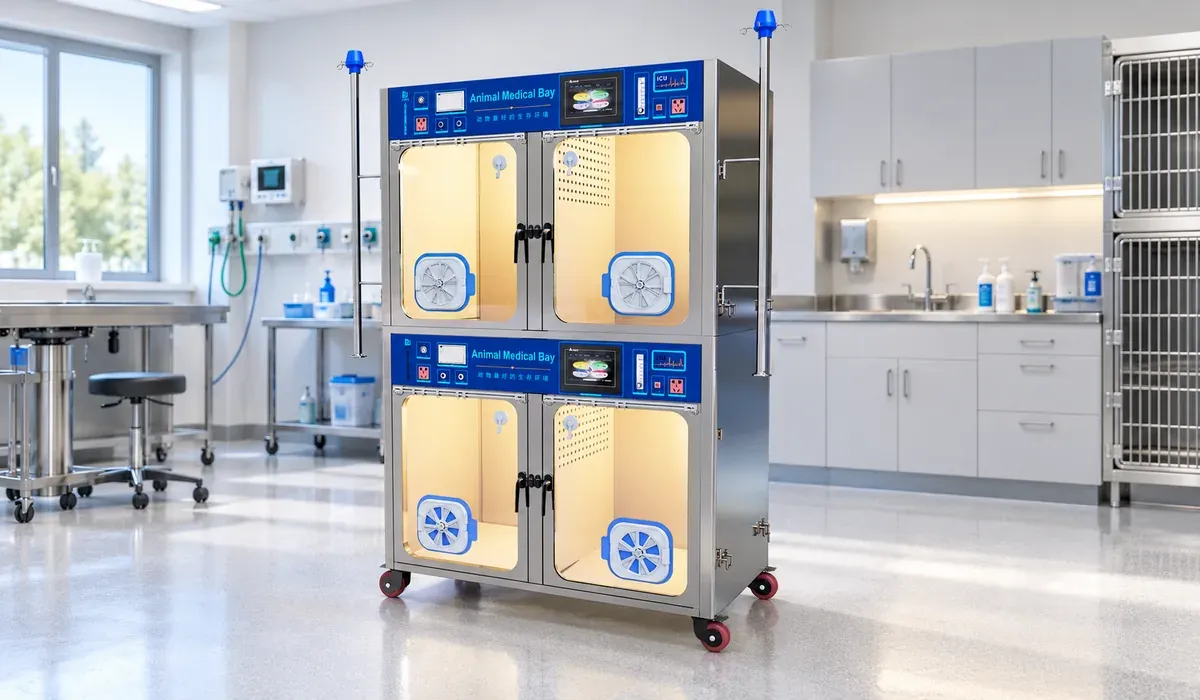
A veterinary ICU cage is more than an enclosed stainless steel compartment. The clinic also has to understand how oxygen is supplied, how temperature is controlled and observed, how alarms and power are handled, and how staff will clean and inspect the equipment between uses. These questions should be answered before a model is ordered or a room is prepared.
Quick answer: what should a clinic confirm before buying?
Confirm the chamber dimensions, construction material, oxygen inlet and exhaust arrangement, temperature-control range and display, alarm functions, visibility, door seals, internal lighting, waste-tray access, electrical requirements and cleaning instructions. Ask for the exact specification sheet and connection drawing for the proposed configuration.
Start with the clinic's monitoring and access workflow
Define where the cage will be observed, how often staff need to open the chamber, which side requires service access and where monitoring records are kept. A clear workflow helps the clinic evaluate door position, control-panel visibility and space around the equipment without making medical decisions from a sales description.
Clarify the oxygen supply and exhaust arrangement
Ask whether the unit connects to a cylinder, wall supply or another specified source, which fittings and pressure conditions are required, and how gas is introduced and exhausted. Confirm the position of every connection and the clearance needed to inspect it. The final installation must follow the supplier documentation and applicable local requirements.
Review temperature controls, displays and alarms
Request the documented control range, display resolution, sensor position, alarm conditions and what happens after a power interruption. Check whether the control panel can be read from the normal observation position. Veterinary professionals should define patient-specific settings and monitoring protocols; the purchasing review should focus on documented equipment capability and usability.
Check visibility without sacrificing practical access
The door and viewing area should let staff observe the chamber while keeping hinges, latches and seals accessible for inspection. Confirm how the door opens, how much aisle space it requires and whether nearby walls or carts interfere. Ask how condensation or surface marks are handled under the documented cleaning procedure.
Inspect the waste tray and internal cleaning path
Look at the internal corners, removable floor or tray, drainage points, seams and areas around sensors or service penetrations. Staff should be able to remove waste trays and reach routine-cleaning surfaces without dismantling unrelated components. Use only cleaning methods and agents supported by the supplier documentation and the clinic's approved protocol.
Confirm power, placement and service clearance
Request the voltage, frequency, plug or hard-wiring requirement and rated power for the exact unit. Keep cables and gas lines organized outside normal walking and wet-cleaning routes. Leave access to ventilation openings, filters, control components and connections. A qualified local professional should review the installation requirements.
Ask how equipment status is checked and recorded
Different configurations may offer different displays, alarms or data functions. Ask what values are shown, whether alarms are visual or audible, how staff verify normal operation and what maintenance records are recommended. Do not assume remote monitoring or data logging unless it is documented for the selected model.
What should you send the supplier?
Send the room dimensions, intended equipment location, doorway sizes, available electrical supply, proposed oxygen source, required quantity and destination market. Ask for the chamber and overall dimensions, utility connections, ventilation and service clearances, alarm description, cleaning instructions, packing dimensions and installation drawing.
Use the documented model description as a starting point
Vetese lists the VTSICU-04 veterinary ICU cage with dual 10L oxygen concentrators, a 3D temperature-control system, oxygen sensing, CO2 monitoring with ventilation control, UV sterilization, atomization and overall dimensions of 1290 x 660 x 1820 mm. These documented specifications are comparison inputs, but the clinic should request the complete technical specification and connection details for the exact configuration before ordering.
Common veterinary ICU cage purchasing questions
Does an oxygen chamber include everything needed for installation? Not necessarily. Confirm the oxygen source, fittings, supply conditions, exhaust arrangement and local installation requirements for the exact configuration.
Is temperature control alone enough for purchasing approval? No. Also review the display, sensor location, alarms, power behavior, chamber access, cleaning method and service clearances.
Who should define oxygen and temperature settings? Patient-specific settings and clinical protocols must be defined by qualified veterinary professionals, not by a purchasing article.
Explore Vetese veterinary cages or contact Nantong Vetese Medical Technology Co., Ltd. with the room plan, utility details and required configuration. Final clinical protocols and technical installation should be reviewed by the appropriate veterinary and local professionals.