Sep 26, 2026Veterinary Equipment Guides
How to Choose a Veterinary Operating Table for Safer Clinic Workflows
A practical guide to choosing veterinary operating tables for stable positioning, easy cleaning, staff access and custom clinic layouts.
Related Vetese resources
Review our Operating & Treatment Tables collection, explore Vetese veterinary equipment, or contact the Vetese factory team about custom dimensions and OEM / ODM requirements.
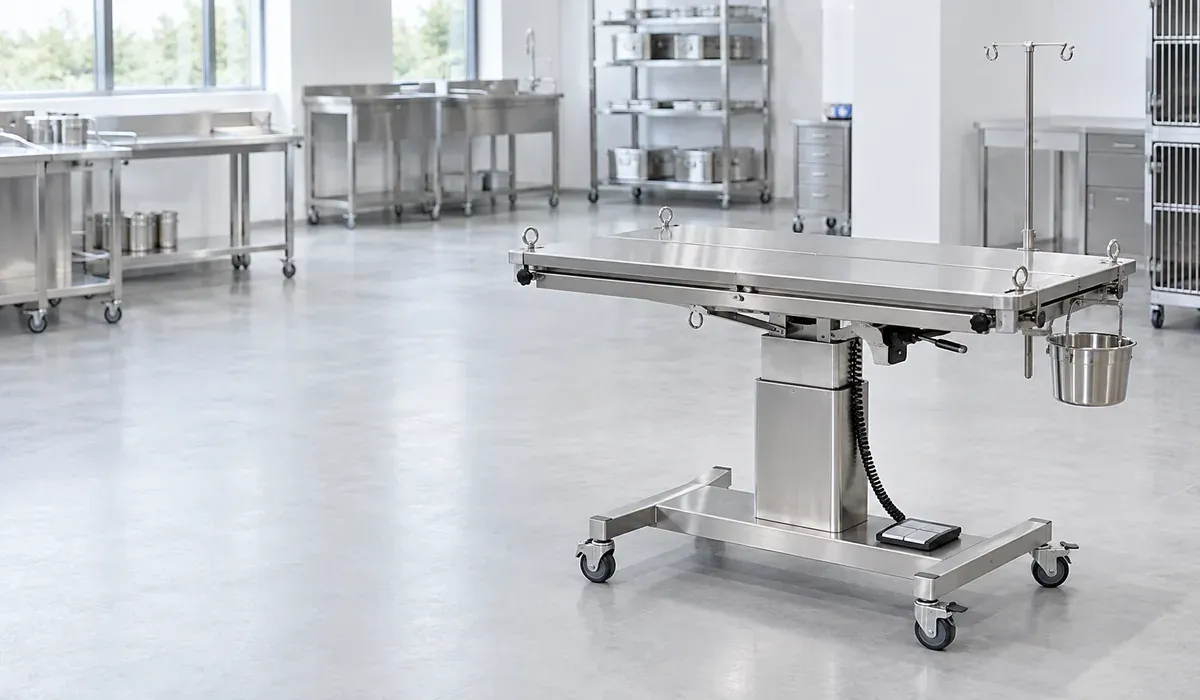
Choosing a veterinary operating table is not only a question of tabletop size or lifting height. The right table should make positioning, cleaning and daily handling predictable for the veterinary team.
Where operating tables create daily problems
A table can look suitable in a catalogue but still slow down a procedure if the surface is difficult to disinfect, the controls are hard to reach or the base blocks staff movement. Before ordering, consider how the table will be used during preparation, treatment and cleaning.
Start with the workflow
Map the tasks performed around the table: patient transfer, restraint, imaging, surgery, recovery and cleaning. Confirm where staff stand, where equipment is parked and how the table will be moved or locked. This prevents a nominally correct size from becoming a daily obstruction.
Check height, stability and access
The working height should support the procedure and reduce unnecessary bending. Ask how the table is adjusted, whether the base remains stable at different heights and whether the controls can be reached without leaving the patient. Rounded edges, drainage options and accessible underside panels also affect cleaning time.
Specify the construction details
For veterinary environments, stainless steel surfaces are practical when welds are smooth and panels are easy to access. Confirm tabletop dimensions, load capacity, restraint points, splash or drainage requirements, casters or fixed feet, and the power or control configuration. These details are more useful than a generic statement that a table is ‘heavy duty’.
Plan custom dimensions before production
Clinics often need a table adapted to a room, a specific animal range or a combined treatment workflow. Send the available space, preferred working height, tabletop size, accessory requirements, quantity and destination market. A marked-up drawing helps the factory confirm the configuration before production.
Vetese manufactures stainless steel veterinary furniture, operating and treatment tables, cages and related equipment in Nantong, China. Our team reviews workflow requirements, custom dimensions and OEM or ODM configurations so buyers can confirm practical details before ordering.