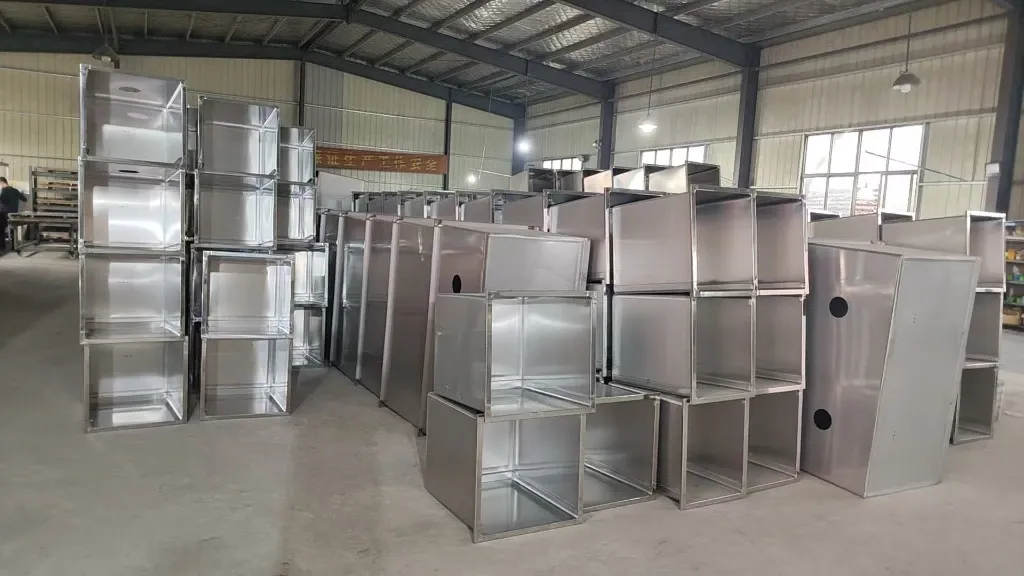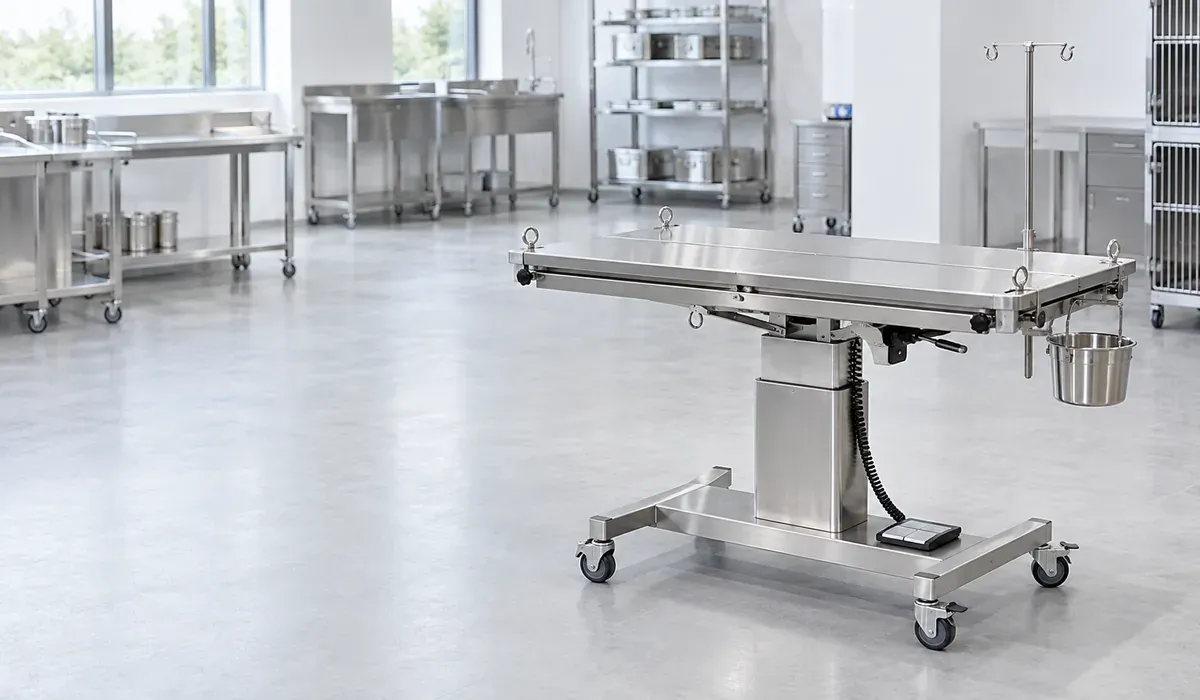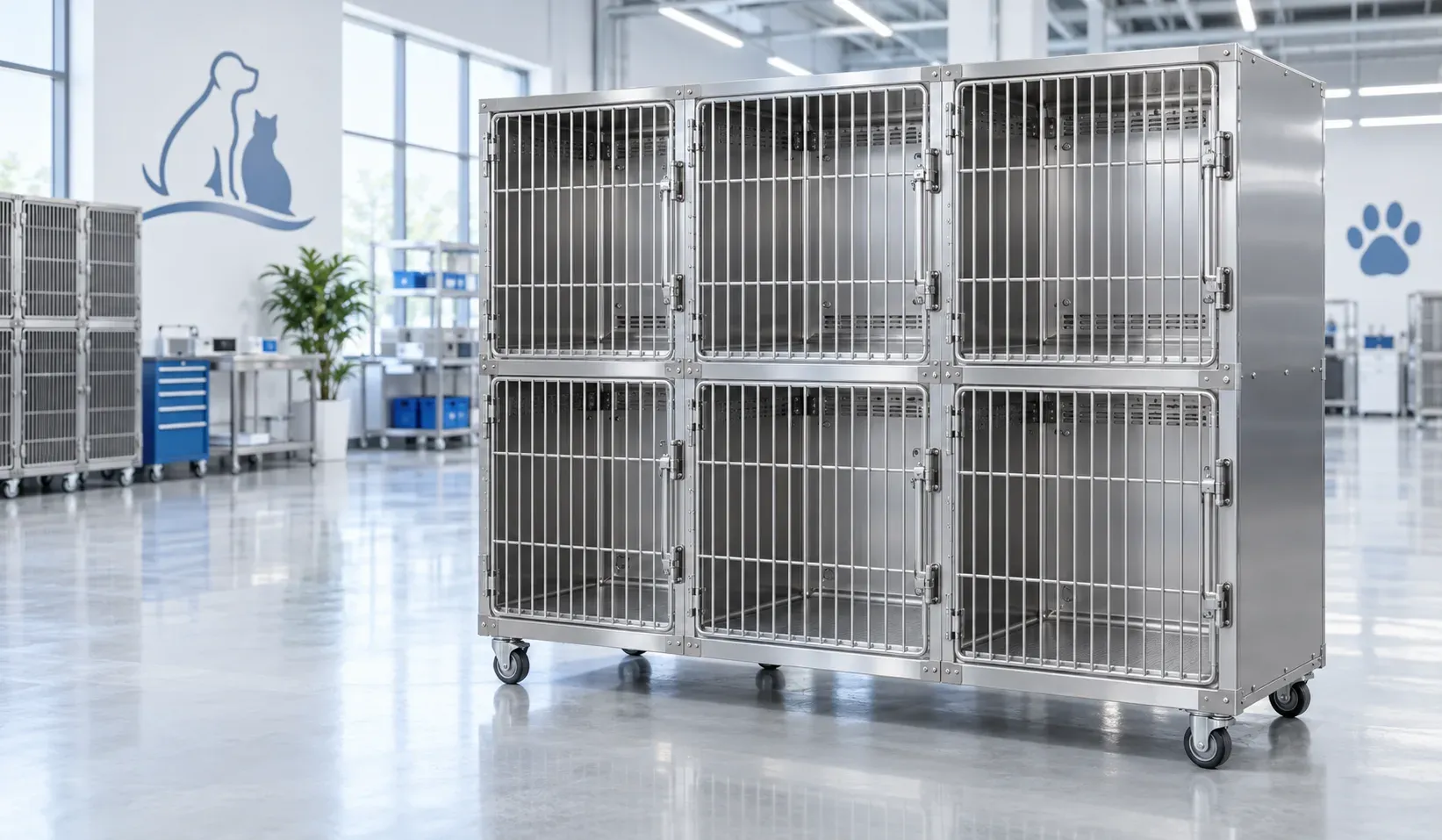
Factory & Manufacturing
Veterinary Equipment Factory Checks: Welds, Dimensions and Function Before Shipping
A cage or table can look right in a photo and still fail in a clinic. Here is what a factory should check — welds, dimensions, moving parts and packing — before it ships.
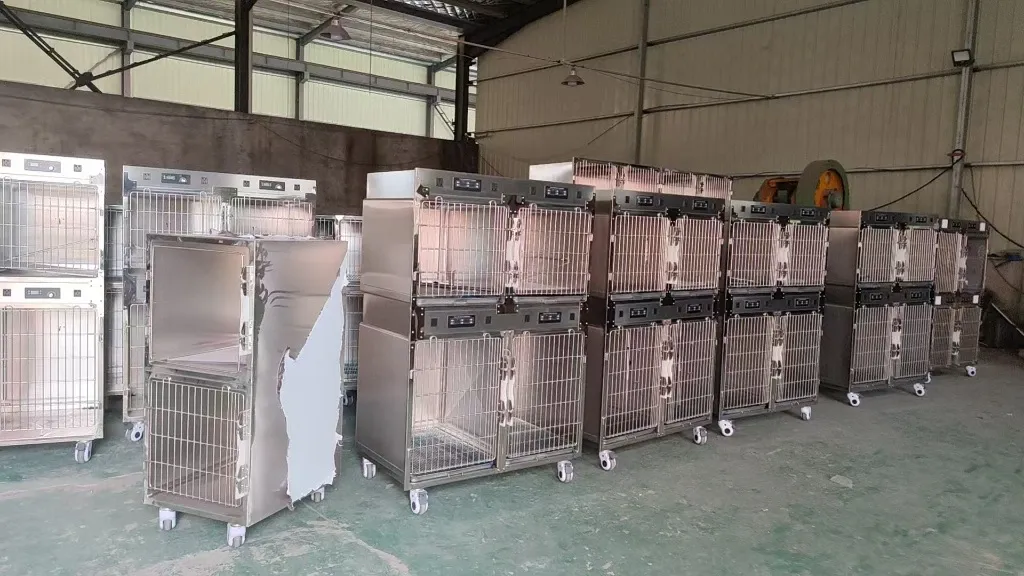
A photo won't tell you if it will last
A cage bank can look perfect in a product photo. The welds are hidden in shadow, the door feels fine because nobody has opened it fifty times yet, and the packed crate looks solid until it arrives with a bent corner.
Most problems in a clinic don't start on delivery day. They start in the factory, in the last hour before packing, when nobody checked one small thing. So if you're buying direct from a factory, ask what gets checked before your order leaves — and in what order.
- Start with the steel, not the shine
Everything else depends on the material. A good check starts before cutting.
- Ask for the mill certificate for the batch, and check the grade on it matches what you ordered — 304 is the usual choice for cages, tables and tubs because it cleans well and resists corrosion.
- Look at the sheet itself. It should be flat, with no dents, scratches or rust spots before work starts. A scratch now becomes a stain later, right where disinfectant sits every day.
- Check the thickness where it matters. A door frame and a side panel don't need the same gauge, but the number on the drawing and the number on the bench should match.
One shortcut buyers use: a magnet test tells you something, but not everything. Some stainless grades are slightly magnetic after forming. Treat it as a rough check, not proof. The certificate is the proof — ask for it and keep it with the order.
- Welds are where cheap work shows first
Ask any fabricator what fails first and they'll point at the welds. A cage lives in a wet, chemical-heavy room. A rough weld traps water, holds disinfectant residue, and rusts from the inside out.
Run your finger — or ask the factory to show you in a photo — along the weld. It should feel smooth and even, with no gaps, holes or sharp spatter. Corners matter most: that's where a cage gets hosed down every day and where a rough joint is hardest to clean.
Good shops check welds in two passes: a visual check for uniformity and penetration, then a closer look for cracks or porosity. Some use magnification or dye-penetrant testing on critical joints. You don't need to know the test names by heart. You need to know the factory does more than glance at it and move on.
If a weld looks ground flat and polished to match the surrounding steel, that's a good sign. If it looks lumpy, dark, or painted over, ask why.
- Measure it like it has to fit through your door
This is the check that saves the most trouble, and the one most often skipped. The factory measures the finished unit against the drawing — length, width, height, door openings, and the space between stacked compartments.
Then measure it again the way your clinic will receive it. Will the assembled cage bank fit through your door? Will the operating table pass the lift? Our delivery checklist covers this from the clinic side; the factory side is the same question in reverse. Packed dimensions are not the same as assembled dimensions, and both numbers should be on the paperwork before the crate is sealed.
A mismatch of 20 mm sounds small. In a prep room with a door frame, a sink and a trolley already in place, it's the difference between installing in an hour and cutting a panel apart on site.
- Open, close, roll, lift — every moving part, every time
A table or cage isn't finished when it's welded. It's finished when it works.
- Doors and latches: open and close each one several times. A latch that sticks on the tenth try will stick on the hundredth, usually with a nervous dog inside.
- Drawers and trays: pull them fully out. They should slide straight, not catch on one side.
- Wheels and brakes: roll the unit, then lock the brakes. It should stop and stay stopped.
- Lights and electrics: switch them on, check the controls, and confirm the plug and voltage match your country before packing — not after the container lands.
Do this on the actual unit you're buying, not a showroom sample. If you're ordering ten cage banks, ask how many get a full function test and how many get a spot check. Both answers are normal. No answer is not.
- Packing is part of the product
The last check happens at the crate. A well-built cage damaged in transit is still a damaged cage.
Good export packing is boring to look at: corners protected, moving parts fixed so they can't swing, glass and lights wrapped separately, and the whole unit braced inside a crate or carton that matches its weight. The packed size and weight should be written on the outside, along with handling marks.
Ask for a photo of the packed unit before it leaves. It takes the factory two minutes and it tells you more than a brochure: you can see whether the crate is actually built around your order, or whether the unit was squeezed in to save space.
Check | What to look for | Why it matters in the clinic |
Material | Mill certificate, grade matches the order | Wrong steel corrodes and stains |
Welds | Smooth, even, no gaps or spatter | Rough welds trap water and bacteria |
Dimensions | Finished size matches the drawing | A unit that doesn't fit can't be installed |
Moving parts | Doors, latches, wheels, lift tested | A sticking latch fails with a patient inside |
Electrics | Controls, plug and voltage checked | Wrong voltage can't be fixed on site |
Packing | Braced, protected, labelled with size and weight | Transit damage is still damage |
FAQ
Should I ask the factory for test reports?
Yes, for the things that matter to you. A mill certificate for the steel is a reasonable ask on any order. Photos of welds, dimensions and packing are reasonable too. If a supplier can't provide any of these, treat that as information.
Is a visual weld check enough?
For most clinic equipment, a careful visual check plus a dimensional and function test catches the common problems. Magnification or penetrant testing is for critical joints. The point isn't the method — it's that someone actually checked, and wrote down what they found.
What if my order arrives damaged?
Photograph the crate before you open it, then the damage inside, and contact the supplier the same day. That is also why the handover checklist matters: it gives your team a fixed routine for recording model, condition and missing parts at delivery.
Request a quote
Buying direct from the factory only works if the factory checks its own work. Send Vetese your product list, dimensions and destination, and ask what checks and documents come with your order. We'll tell you plainly what we test before shipping, and what to check when it arrives.